Pallet Flow Racking: Optimising Inventory Management in Warehouses
In today’s competitive warehouse environment, businesses must maximise space while maintaining efficient product movement. This storage approach offers a practical solution by combining high-density storage with controlled stock rotation. Pallet flow racking is designed to maximise storage density while maintaining consistent FIFO stock rotation in busy warehouse environments.
This gravity-based pallet flow system supports the first-in, first-out (FIFO) principle. As a result, it performs particularly well in operations where stock freshness, throughput, and consistency matter. Below, we explore how pallet flow racking systems work, where they perform best, and what to consider before installation.

What is Pallet Flow Racking?
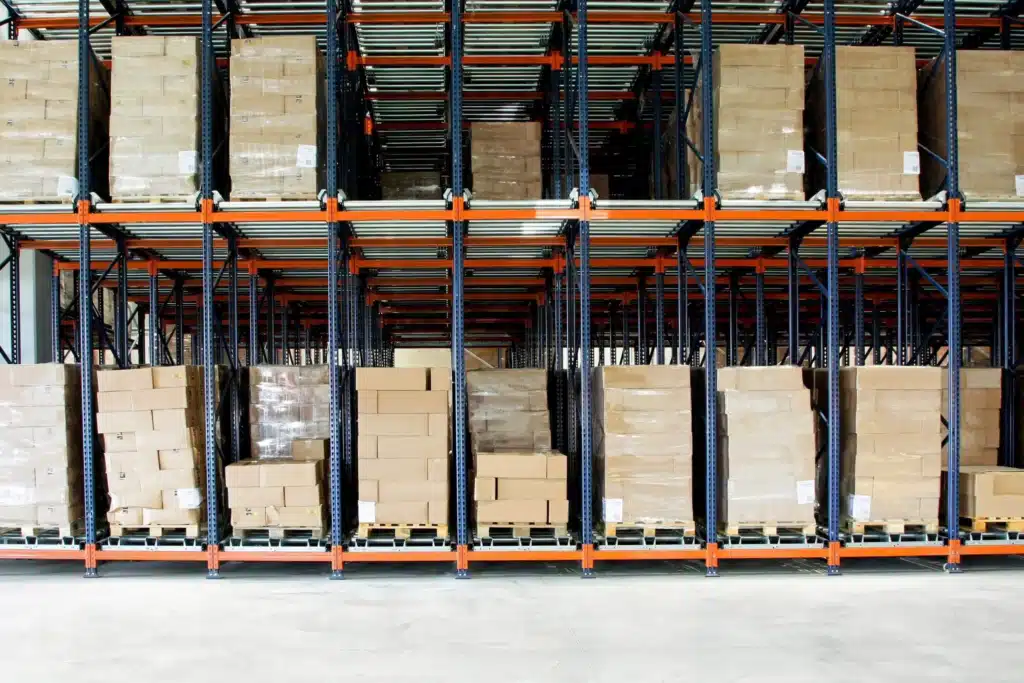
Pallet flow racking is a gravity fed racking system designed to improve storage density and inventory control. It uses slightly inclined lanes fitted with rollers or wheels.
Operators load pallets at one end, and gravity moves them smoothly towards the picking face. Consequently, when teams remove a pallet from the discharge side, the next pallet automatically advances into position. This continuous movement makes flow through pallet racking ideal for FIFO stock management.

Key Benefits of Pallet Flow Racking
This type of flow racking delivers several operational advantages.
- Consistent stock rotation: As a result of automatic pallet movement, teams always access the oldest stock first. Consequently, this reduces waste for date-sensitive goods.
- Improved space utilisation: By storing pallets multiple-deep, warehouses reduce the number of aisles required. Therefore, available floor space works harder without expanding the building footprint.
- Faster picking and replenishment: Since loading and unloading take place at opposite ends, forklift travel time reduces significantly. In turn, this improves throughput and productivity.
- High-density storage capacity: Compared to conventional selective racking, a gravity racking system stores more pallets within the same footprint. As a result, storage capacity increases without compromising access.
- Reduced product handling: Fewer forklift movements lead to less manual handling. Consequently, businesses benefit from lower damage risk and improved workplace safety.
Ideal Applications
Flow racking systems work best in environments that demand speed, accuracy, and volume, including:
- Warehouses handling high-volume, fast-moving stock
- Operations requiring strict FIFO control, such as food and beverage distribution
- Businesses seeking to maximise storage without expanding their warehouse footprint
For example, many temperature-controlled facilities rely on pallet flow systems to maintain product integrity while keeping throughput high

Key Considerations Before Installation
Although this storage solution offers clear benefits, careful planning remains essential.
- Product consistency: Pallets should have uniform dimensions and stable loads. As a result, products move smoothly along the rollers without interruption.
- Warehouse layout: Sufficient space must be available at both loading and picking faces. Therefore, designers should consider traffic flow and operational access early in the planning stage.
- Load capacity and design: Each flow lane must support the correct pallet weight, size, and throughput requirements. Consequently, accurate load data is critical during system design.
- Inspection and maintenance: Regular checks of rollers, brakes, and tracks help maintain performance and long-term safety. Guidance from industry bodies such as the Health and Safety Executive can help inform inspection schedules and racking safety management.

Why Pallet Flow Racking Improves Warehouse Efficiency
When designed correctly, this gravity racking system helps warehouses balance capacity, speed, and control. Not only does it support reliable FIFO operation, but it also reduces wasted space and unnecessary handling.
Therefore, for businesses focused on productivity and scalability, this type of pallet flow system represents a long-term investment in operational efficiency.
Arrange a Free Site Visit and Consultation
If you are considering a pallet flow system for your warehouse, a professional site assessment ensures the installation matches your operational needs. A tailored design will maximise performance, safety, and return on investment.
Contact us today to arrange a free site visit and consultation.
FAQs About Pallet Flow Racking
- How does pallet flow racking support FIFO stock control?
Because pallets advance automatically after removal, operators always pick the oldest stock first. - Is pallet flow racking suitable for every product type?
Generally, it performs best with consistent pallet sizes and evenly distributed loads. - What safety factors should be considered?
Correct system design, appropriate load ratings, and routine inspections are essential for safe operation. - Can pallet flow racking work alongside other systems?
Yes. Many warehouses combine flow racking with selective or drive-in racking to suit different stock profiles. - How does flow racking compare with traditional pallet racking?
Flow racking provides higher storage density and improved stock rotation, particularly where FIFO is required